
Have you ever received a text and thought, “Was that rude or just a joke?“ You’re not alone. The word “mean” in text carries multiple layers it can describe someone’s unkind behavior, clarify a person’s intention, or simply help decode unfamiliar digital communication. In everyday chats on WhatsApp, Instagram, Snapchat, and TikTok, the word shifts meaning based entirely on context and tone.
A single message without vocal cues can feel harsh even when the sender meant zero harm. That’s the real challenge with “mean” in text today. In this guide, you’ll uncover the true meaning, real-life usage, relatable examples, and how it shows up across every major social media platform.
What Does “Mean” in TextQuick Meaning
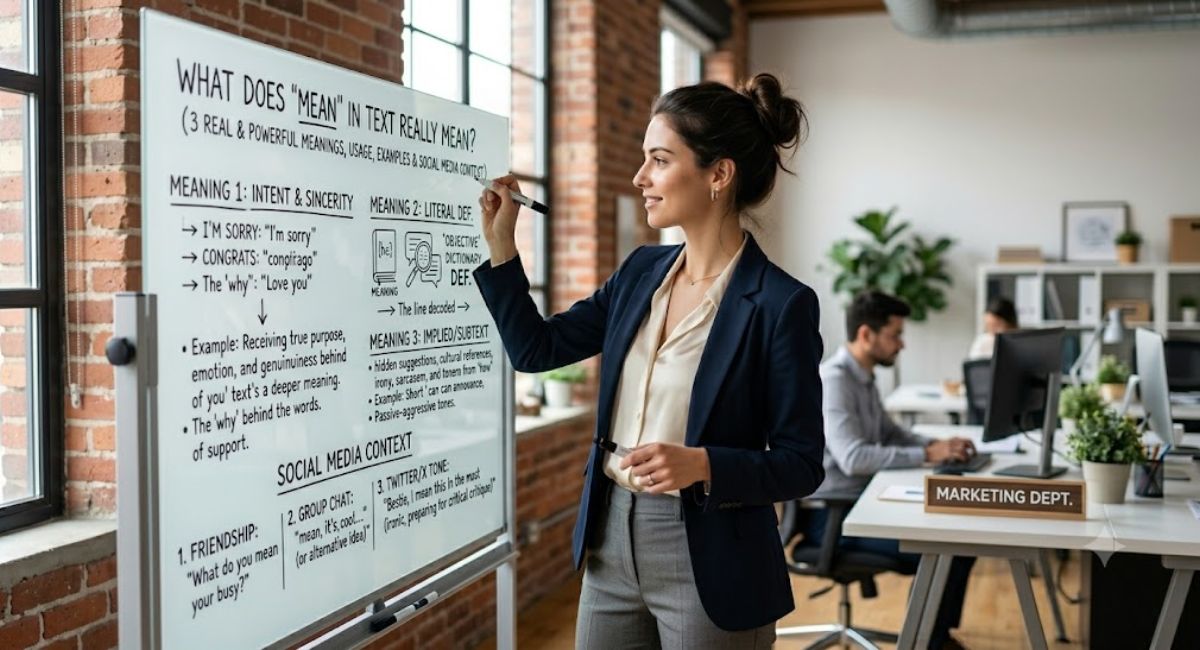
🔑 Quick Answer: When someone uses the word “mean, it most commonly refers to one of three things:
Intention or significance → “I didn’t mean it that way.”
Unkind or hurtful behavior → “Why are you being so mean?”
Seeking clarification → “What does this mean in text?”
In the context of modern texting and social media, “mean almost always relates to either emotional behavior (describing someone as cruel or rude) or intent clarification (asking what a word or message is supposed to signify).
| Usage | Example | Platform |
| Unkind behavior | “That comment was really mean 😤” | Instagram, WhatsApp |
| Intention | “I didn’t mean it like that!” | iMessage, Snapchat |
| Clarification | “What does this mean in text?” | Google, TikTok |
| Sarcasm/humor | “Okay that’s a little mean lol 😂” | Twitter/X, Discord |
Understanding “mean” in text correctly saves you from awkward misunderstandings, broken friendships, and unnecessary drama online. 👇
Origin & Background of the Word “Mean”
📖 The word “mean” has a surprisingly deep history that dates back centuries.
See also What Does “!!” Mean in a Text Reply? A Complete, Real Meaning Explained 2026
Old English Roots
The word originally comes from Old English mænan, which meant “to intend, to signify, or to mention.” It was a straightforward verb purely about intention and communication.
Middle English Evolution
By the Middle English period, “mean” expanded to include a moral dimension. It began describing someone who was low in status, base in character, or stingy in nature. This is where the modern sense of “unkind behavior” started developing.
Modern English & Digital Age
Fast forward to today, and “mean” has evolved into a multifaceted word used across:
💬 Text messages (WhatsApp, iMessage, SMS)
📸 Social media (Instagram DMs, TikTok comments, Snapchat chats)
🎮 Gaming chats (Discord, Xbox messages)
💼 Professional messaging (Slack, Teams)
In the digital communication era, because messages lack vocal tone and facial expressions, the word “mean” in text has become especially tricky to interpret. Short, fast messages strip away context making it easy to misread someone’s intention.
This is why millions of people search “what does mean in text” every single day. 🔍
Real-Life Conversations (How It Actually Appears in Text)
Here’s how “mean” in text shows up in actual everyday chats. These examples cover multiple platforms so you can recognize the pattern instantly. 👇
💬 WhatsApp Example Unkind Behavior
Person A: “You always cancel plans lol” Person B: “Okay that’s mean 😒 I had a reason though” Person A: “I didn’t mean it in a bad way, I promise!”
📱 iMessage Example Seeking Clarification
Person A: “She went full ‘no cap’ on me” Person B: “Wait what does that mean in text?” Person A: “It means she was being 100% honest, no lies”
🎵 TikTok Comment Example Describing Mean Energy
Comment: “The way she said that was genuinely mean 💀” Reply: “Right? The tone was giving mean girl vibes 😭”
💜 Snapchat Example Clarifying Intent
Person A: “Lmao you’re hopeless 😂” Person B: “Was that mean or are you joking rn??” Person A: “JOKING!! You know I love you lol”
🎮 Discord Example Gaming Context
User1: “Your aim is so bad bro 💀” User2: “That’s kinda mean ngl” User1: “Bro it’s just banter relax 😂”
These examples show exactly how “mean” in text shifts depending on the relationship, platform, and tone used. Same word completely different emotional impact every time. 🎯
Emotional & Psychological Meaning Behind “Mean”

When someone says “that’s mean” in a text, it isn’t just a word choice. It carries real emotional weight. Here’s what’s happening psychologically:
😔 Feeling Hurt or Dismissed
When someone uses “mean” in text to describe another person’s behavior, they’re often expressing that they felt:
Belittled or talked down to
Dismissed without empathy
Publicly embarrassed in a group chat
Misunderstood by someone they trusted
😤 Setting a Boundary
Sometimes saying “that was mean” in a text message is the sender’s way of:
🛑 Flagging that a line has been crossed
📢 Asking for an apology without demanding one outright
💬 Opening the door for a conversation about how they feel
🤔 Seeking Clarity on Intent
In many cases, the word “mean”appears when someone genuinely isn’t sure if the other person intended to be hurtful. Phrases like “did you mean that?” or “that came off really mean” are digital-age ways of checking in before reacting.
Because text messages remove facial expressions, voice tone, and body language, a perfectly innocent joke can land like a genuine insult. This emotional ambiguity is what makes understanding “mean” in text so important. 💡
Usage in Different Contexts
The word “mean” in text doesn’t behave the same way everywhere. Here’s how it changes across different environments:
See also What Does TIA Mean in Text? 5 Real Meanings, Usage, and Examples Explained Simply
🏠 Personal / Casual Texting
Used freely among friends
Often softened with emojis (😂, 😭, 💀)
Mostly describes behavior: “don’t be mean lol”
📸 Social Media (Instagram, TikTok, Twitter/X)
“Mean comments” = harsh, negative, or bullying remarks
“Mean energy” = a sarcastic, cold, or dismissive vibe
“Mean girl behavior” = clique-like or socially exclusionary actions
TikTok and Instagram Reels often label content as “mean but accurate 💀” meaning brutally honest
💼 Professional Messaging (Slack, Teams, Email)
The word “mean” in text rarely appears in professional settings in the behavioral sense
Instead, “what do you mean by that?” is more common when seeking clarification
Using “that’s mean” in a work chat is considered unprofessional
🎮 Gaming & Discord
“Mean” is frequently used as playful banter between teammates
Often paired with “lol,” “ngl,” “💀” to signal humor vs. genuine offense
Mean trash-talk is part of gaming culture, but context still matters
💕 Dating Apps (Tinder, Bumble, Hinge)
“You’re mean 😏” can be flirtatious and playful
Context determines everything the same phrase can be teasing or genuinely hurtful
Misreading “mean” in text on a dating app can kill an early connection fast
Common Misunderstandings
❌ Here are the most frequent misconceptions people have about “mean” in text:
Misunderstanding #1: “Mean Always Equals Rude”
Not true. “I didn’t mean it that way” is about intention, not rudeness. People confuse the two senses all the time, which creates unnecessary arguments.
Misunderstanding #2: “If Someone Says You’re Being Mean, You Are”
One person’s perception isn’t always objective reality. Sometimes a dry humor style is misread as “mean” in text by someone who doesn’t know you well.
Misunderstanding #3: “Emojis Cancel Out a Mean Message”
Adding 😂 or 💀 after a hurtful statement doesn’t automatically make it okay. Many people use humor emojis to soften genuinely unkind words this is called “joking not joking” behavior online.
Misunderstanding #4: “Mean Only Describes Bad People”
In reality, even the kindest people say things that come across as mean in text because digital communication removes the warmth of in-person delivery. A caring message can land wrong. Context is everything.
Misunderstanding #5: “Mean in Text Is the Same as Cyberbullying”
They’re not the same. A single message being “a bit mean” doesn’t equal cyberbullying. Cyberbullying involves repeated, targeted, intentional harassment. One thoughtless comment is not the same thing.
Comparison Table
Here’s a clear breakdown of how “mean” in text compares to related words and concepts: 📊
| Term | Definition | Example in Text |
| Mean | Intentionally unkind or hurtful | “That was so mean of you 😔” |
| Rude | Disrespectful, often unintentional | “He was rude but didn’t mean it” |
| Sarcastic | Saying the opposite of what you mean | “Oh wow, great job 🙄 (sarcasm)” |
| Blunt | Direct but not necessarily unkind | “I’m just being honest, not mean” |
| Passive-Aggressive | Indirect hostility | “Fine. Whatever. 😐” |
| Harsh | Severe or overly critical | “That feedback was harsh but fair” |
| Cold | Emotionally distant in text | “She just replied ‘k’ — so cold 😬” |
Understanding these differences helps you use and interpret “mean” in text with far more accuracy. 🎯
Variations & Types of “Mean” in Text (10 Common Forms)
Here are the 10 most common ways “mean” in text actually shows up in real digital conversations:
See also What Does “W” Mean in Text? 7 Best Real-Life Meanings Explained
1️⃣ “That’s Mean” Emotional Reaction
The most classic use. Someone is expressing that they felt hurt by a message or comment.
“You forgot my birthday? That’s mean 😢“
2️⃣ “What Do You Mean?” Seeking Clarification
Used when a message is confusing, vague, or ambiguous.
“Wait, what do you mean you’re not coming? 😟”
3️⃣ “I Didn’t Mean It” Denial of Intent
A defensive clarification after saying something that landed badly.
“I swear I didn’t mean it like that, you know me 😭“
4️⃣ “That’s So Mean Lol” Joking Acknowledgment
When the “mean” comment is actually funny and both parties know it.
“You told him that?? That’s so mean lol 💀”
5️⃣ “Mean Girl Energy” Cultural Reference
Referencing a cliquey, exclusionary, or catty social behavior.
“The way she excluded her from the group chat is pure mean girl energy 😤”
6️⃣ “Mean Comments” Online Criticism
Referring to negative, hurtful remarks left on social media posts.
“Why do people leave such mean comments on her videos? 😔”
7️⃣ “You’re Mean 😏” Flirtatious Teasing
In romantic or playful contexts, calling someone “mean” can actually be endearing.
“Stop making me laugh, you’re so mean 😏”
8️⃣ “Mean but True” Brutally Honest Observation
Popular on TikTok and Twitter/X, used when someone says something harsh but accurate.
“That meme about Mondays is mean but so true 😂”
9️⃣ “What Does [Word] Mean in Text?” Slang Research
The most Googled format people asking for the definition of a word used in a chat.
“He said ‘slay queen’ what does that mean in text?”
🔟 “That Was Mean of Them” Third-Party Judgment
Describing someone else’s behavior in a conversation or story.
“She literally ghosted him after 3 years. That was mean of her 💔”
How to Respond When Someone Says You’re Being “Mean”
😬 So someone just texted you “that’s mean” or “why are you being so mean?” now what?
Here’s how to handle it gracefully depending on the situation:
✅ If You Didn’t Intend to Be Mean:
Acknowledge their feeling first → “I’m really sorry, I didn’t mean it that way at all.”
Clarify your actual intent → “I was trying to be funny, not hurtful.”
Ask how you can make it right → “What can I do to clear this up?”
✅ If You Were Joking (But It Landed Wrong):
Don’t immediately get defensive
Say something like: “That was my attempt at banter, but I see how it came off sorry 😔”
Avoid the classic mistake of saying “it was just a joke” without acknowledging their feelings first
✅ If the Accusation Isn’t Fair:
Stay calm and don’t match their energy with defensiveness
“I understand you felt that way. Can we talk about what specifically felt mean so I can understand better?”
Keep the tone open, not confrontational
❌ What NOT to Do:
🚫 Don’t send back “you’re being too sensitive”
🚫 Don’t leave them on read
🚫 Don’t double down with “I meant it 😐” unless you’re okay with damaging the relationship
🚫 Don’t send an essay of justification keep your response human and real
Differences Between Formal and Informal Meaning in Text

📋 The word “mean” in text behaves very differently depending on whether you’re in a casual or professional communication space.
Informal (Casual Texting & Social Media)
💬 Used to describe behavior: “That was mean”
🤔 Used to question intent: “What did you mean by that?”
😂 Often paired with humor: “Okay that’s mean but fair lol”
🔥 Social media slang: “mean girl,” “mean energy,” “mean but accurate”
Formal (Professional & Academic Communication)
📧 “What do you mean by this point?” = requesting clarification
📊 “The mean of the dataset is 45.6” = mathematical average
📝 “Could you clarify what you meant in paragraph 3?” = academic writing feedback
💼 Emotional uses of “mean” in text are almost never appropriate in formal settings
The biggest difference? In informal texting, “mean is almost always emotional. In formal communication, it’s almost always definitional or mathematical. Never mix them up in a professional message! 💡
Psychological Impact of Meaning in Text
The way we receive and interpret “mean has real psychological consequences. Researchers in digital communication have noted several patterns:
See also What Does SOS Mean in Text? 7 Amazing Real Meanings You Need to Know”
🧠 The Ambiguity Effect
Because texts lack vocal tone, readers often assume the worst-case interpretation of an ambiguous message. This means a neutral or joking message can feel genuinely mean in text even when the sender had zero harmful intent.
💔 Text-Based Hurt Feelings Last Longer
Studies in digital communication psychology suggest that hurtful written messages can linger longer than spoken ones because:
People re-read texts multiple times
Screenshots preserve the moment permanently
There’s no immediate face-to-face response to soften the blow
😰 The “Typing Bubble” Anxiety
Waiting for a response after sending a message you’re worried came off as mean in text creates genuine stress. The three-dot typing indicator has become a source of social anxiety for millions of people.
🔁 The Rumination Loop
After receiving a message that feels mean in text, many people:
Re-read it multiple times looking for softer interpretations
Screenshot and share it with friends for a second opinion
Spend hours wondering if they should respond or stay silent
Understanding this psychological cycle helps both senders and receivers navigate digital communication with more empathy and intentionality. 💚
Future of Meaning in Text Communication
🔮 The way “mean” in text is understood is evolving rapidly alongside technology. Here’s where things are headed:
🤖 AI-Powered Tone Detection
Apps like Gmail and some messaging platforms already use AI to flag potentially harsh tones before you send a message. In the near future, your phone might warn you: “This message may come across as mean would you like to rephrase it?”
🎭 Emoji & Reaction Layers Replacing Words
As communication becomes more visual, the single word “mean” is increasingly being replaced by reaction emojis. A 😤 or 💔 reaction to a message communicates “that felt mean” without needing to type it.
🌐 Cross-Cultural Texting Norms
With global digital communities growing, what feels mean in text in one cultural context may be perfectly normal in another. Directness is rude in some cultures; warmth-without-directness reads as passive-aggressive in others.
🗣️ Voice & Video Replacing Text for Emotional Topics
More Gen Z users are switching to voice notes and short video messages (à la TikTok DMs) for emotionally charged conversations precisely because text strips away nuance. The future of “mean” in text may be fewer text-based misunderstandings overall.
Expert Tips to Understand Meaning in Text Better
💡 Here are practical, expert-backed strategies for navigating “mean” situations like a communication pro:
✅ Tip 1: Read the Whole Conversation, Not Just One Message
A single line rarely tells the whole story. Always read the full thread before deciding if something is mean in text or just poorly worded.
✅ Tip 2: Look at the Emoji Context
Emojis are the punctuation of digital speech. A 😂 after a harsh comment usually signals humor. A 😐 or 🙄 often signals genuine irritation. Read them carefully.
✅ Tip 3: Consider the Platform
A dry, blunt message on Discord between gamers hits differently than the same words in a WhatsApp group chat with family members. Context of the platform matters enormously.
✅ Tip 4: Ask Rather Than Assume
If a message seems mean in text but you’re not sure, just ask. “Hey, did you mean that as a joke or were you being serious?” It takes 5 seconds and saves hours of overthinking.
✅ Tip 5: Default to the Charitable Interpretation First
Before assuming someone was being mean, consider: “Could they have meant this kindly and I just can’t hear their tone?” Most digital miscommunications come from tone, not intent.
✅ Tip 6: Don’t Over-Rely on Abbreviations in Emotional Conversations
When discussing something sensitive, spell things out. Saying “idc” when someone is upset reads as extremely mean in text even if you genuinely just meant “it’s fine either way.”
✅ Tip 7: Follow Slang Trends to Stay Current
New words and abbreviations appear constantly. If you’re not sure what something means in text, don’t guess a quick search will give you the answer in seconds.
Frequently Asked Questions
Q1: What does “mean” in text really mean in everyday conversations?
In everyday texting, “mean” in text most commonly describes unkind or hurtful behavior (“that was mean”) or asks for clarification about someone’s intention (“what do you mean?”). Context always determines which sense is intended.
Q2: Is calling someone “mean” in a text considered cyberbullying?
No a single comment described as mean in text is not cyberbullying. Cyberbullying involves repeated, targeted, intentional harassment. One thoughtless message is different from ongoing abuse.
Q3: Why does a message feel mean even when the sender didn’t intend it that way?
Because text removes vocal tone, facial expressions, and body language the three cues we rely on most to interpret emotion. What means kindness face-to-face can feel cold or harsh in text form.
Q4: How do I know if someone is using “mean” in text to be funny or if they’re genuinely upset?
Look for humor signals: emojis like or “lol” usually indicate joking. If the message is blunt with no softeners no emoji, no “jk,” no “lol” it’s more likely they’re being genuine about feeling hurt.
Q5: What’s the best way to respond when someone says I’m being “mean” in a text?
Acknowledge their feeling first, clarify your actual intent without being defensive, and ask what you can do to make it right. Never respond with “you’re too sensitive” it always makes things worse.
Final Thoughts
Understanding what “mean” in text really says is one of the most useful skills you can develop as a modern digital communicator. 📱💬
Whether it’s someone telling you “that’s mean 😭,” you asking “what does this mean in text?” or decoding the subtle difference between playful banter and genuine hurt feelings context, tone, platform, and relationship all shape how this tiny word lands.
The key takeaways? 🎯
✅ “Mean” most often signals unkind behavior OR a request for clarification
✅ Always read the full context before reacting to a potentially mean message
✅ Emojis, punctuation, and platform all change how “mean” is interpreted
✅ When in doubt, ask clarification is always better than assumption
✅ Digital communication lacks tone; be extra intentional with your words
The more you understand “mean across its many forms and contexts, the better you’ll communicate, the fewer misunderstandings you’ll face, and the stronger your digital relationships will be. 💚
Now that you know everything about “mean” go communicate with confidence! 🚀

Hi, I’m Dua I create guides, reviews, and tips to help you make money online, grow your websites, and succeed in the digital world. I test tools, hosting services, and affiliate programs so you don’t have to. Follow along to discover smart ways to earn online in 2026!”